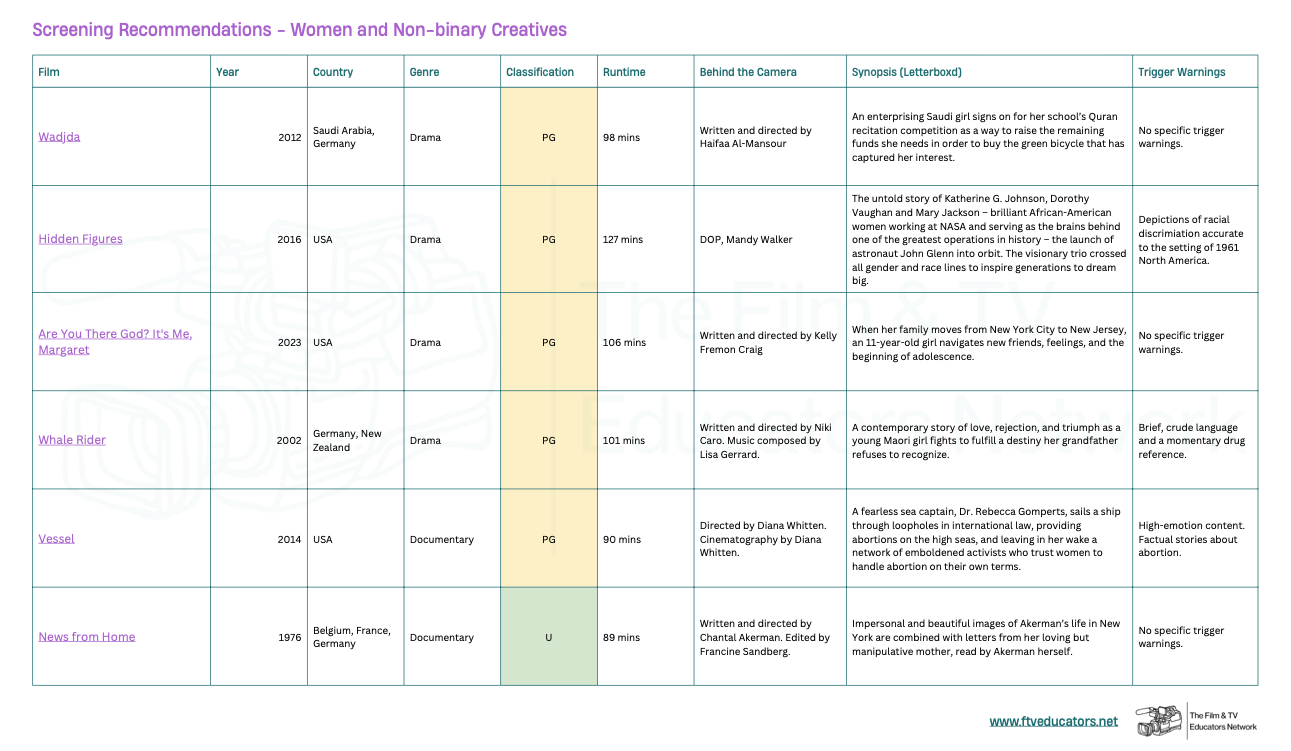
Screening Recommendations: Women and Non-binary Creatives
At the beginning of the year, the Centre for the Study of Women in Television and Film released Dr. Martha M. Lauzen’s report, The Celluloid Ceiling: Employment of Behind-the Scenes Women on Top Grossing U.S. Films in 2025.
The report analyses the percentage of women who were employed in roles behind the camera for the top grossing U.S. films in 2025, and unfortunately, the findings are a disappointing read.
“In 2025, 75% of the top 250 grossing films employed 10 or more men in pivotal behind-the-scenes roles, but only 7% employed 10 or more women. Last year, women accounted for 23% of directors, writers, producers, executive producers, editors, and cinematographers working on the top 250 grossing films, even with 2024. Women comprised 21% of individuals in these roles on the top 100 grossing films, up 1 percentage point from 2024.”
Are We Actively Demonstrating Non-Male Talent to Students?
Screen industries are dominated by male figures. Whether it’s discussing award-winning films, the highest-rated TV shows, or popular research, so often the centre of the discussion is the product of a male figure. Additionally, it is often a Western male figure and predominantly of white ethnicity. In the past, this was partly due to a lack of available options for screenings or research, but this is no longer the case.
Though Dr. Lauzen’s report is specific to U.S. screen industry, as educators, it’s essential we ensure students feel represented by the examples we ask them to engage with in class and in their own time. Not only this, but it’s also important that all students understand that there is a place for everyone in the screen industries and in all roles.
To do this, we must scrutinise the examples we share and highlight exceptional work from a wide variety of talent.
Screening Recommendations
To support access for educators to films with women and non-binary creatives behind the camera, we have created a downloadable resource. The resource includes:
Links for each film to the Letterboxd page where you can also see if the film is available to stream, rent, or buy on different platforms
The film’s age classification
The creatives involved in the film and the roles they had in production
A synopsis from Letterboxd giving an overview of the film content
Specific trigger warnings. We have made effort to include as much as is available here, but we will always recommend educators view the film themselves before screening in a classroom to ensure it is suitable.
This is not a definitive list but a starting point for educators who can make changes to their examples to include more diverse content.
Feel we are missing something? Please get in contact with further suggestions so we can update this list in the future hello@ftveducators.net
Thank you to the teachers who supported us with adding recommendations to the list!